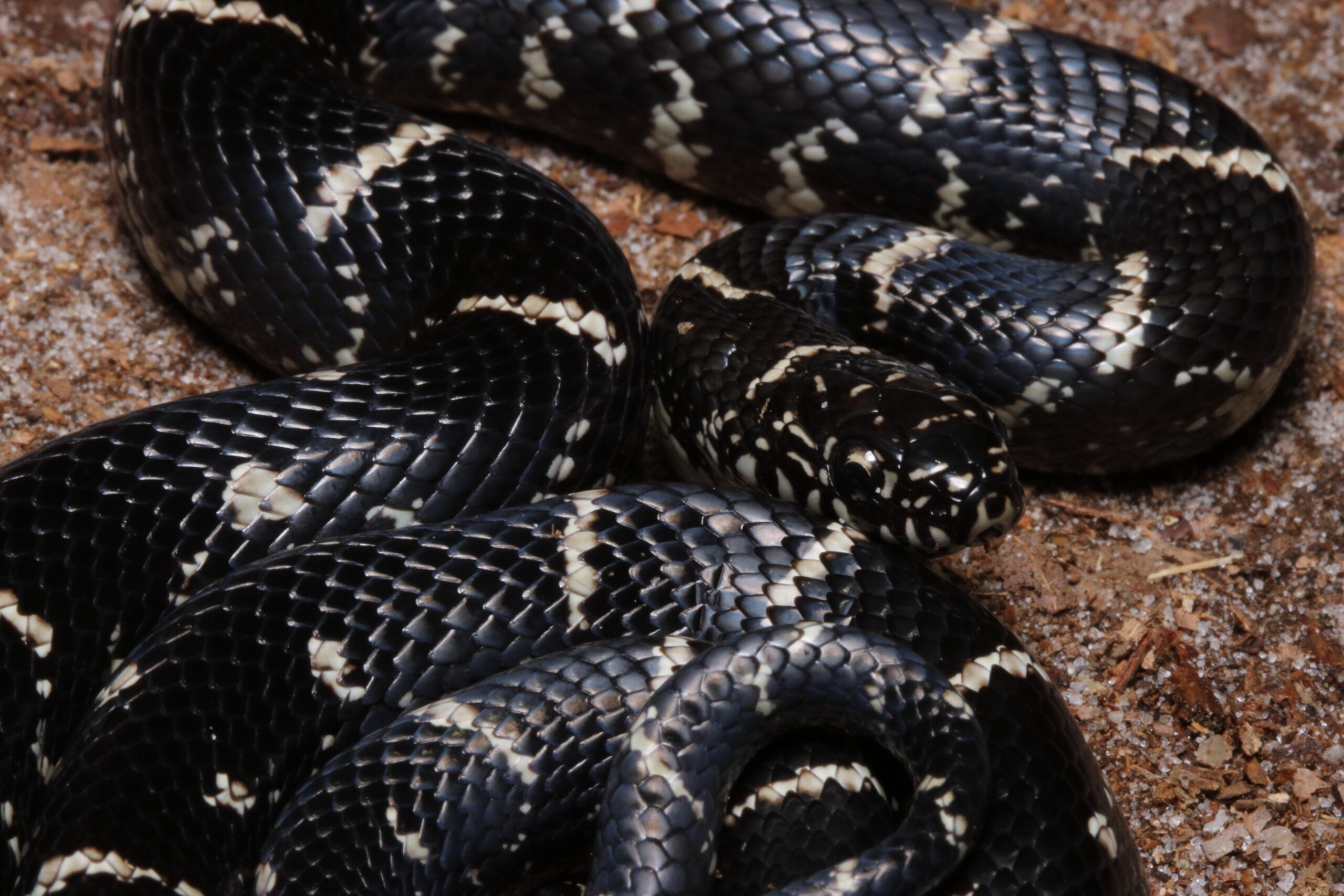
King Snake (Lampropeltis) is the common name used here for the living genus Lampropeltis, a group that includes kingsnakes and milk snakes. Because the genus contains many species, colors, sizes, habitats and conservation needs cannot be reduced to one species-level value. This guide separates well-supported biology from common assumptions and covers identification, range, habitat, diet, behavior, reproduction and conservation.
Identification
Members of Lampropeltis have smooth, glossy-looking scales and highly variable patterns. Many have pale bands, rings, stripes or speckles on darker backgrounds, while milk snakes often combine red, black and pale bands. Identification requires location, scale details and the complete pattern rather than color alone. Sexes are usually difficult to separate reliably by external appearance. Body size, tail proportions and pattern vary more among species and populations than a genus-wide male-versus-female description would suggest.
Identification should combine body shape, markings, size, voice or movement, and location. One feature by itself can overlap with a related animal, a juvenile, or an individual in unusual light.
Photographs are most useful when they preserve scale and show several diagnostic features. Handling or repositioning a wild king snake for identification can cause stress and is unnecessary.
Size and physical adaptations
Body length and weight differ widely among member species, ages and conditions, although many kingsnakes are medium-sized snakes. A genus overview cannot provide a single responsible maximum. For example, National Park Service accounts often describe local California kingsnakes near 3 feet, while other Lampropeltis species and exceptional individuals differ.
Its useful adaptations include smooth glossy scales, powerful constriction, resistance to some pit-viper venoms in certain species, chemical sensing with a forked tongue, cryptic or warning-like color patterns. These traits work together in the animal’s normal setting rather than serving as isolated curiosities.
Published measurements may use different methods, life stages or sample locations. Comparing figures responsibly means checking what was measured rather than selecting the largest number available.
Range and distribution
Lampropeltis is a New World genus distributed from southern Canada through the United States and Mexico into parts of Central America and northern South America. The native range includes Canada, United States, Mexico, Guatemala, Belize, Honduras, El Salvador, Nicaragua, Costa Rica, Panama, Colombia, Ecuador.
A country-level map indicates broad distribution, not continuous occupation. Climate, elevation, water, vegetation, prey, breeding sites, barriers and survey effort all affect where records occur.
Records near the edge of the range deserve careful documentation because they may reflect natural movement, improved survey coverage, accidental transport or a genuine distribution change.
Habitat
Different kingsnakes occupy forests, pine barrens, grasslands, scrub, deserts, rocky uplands, wetlands, farms and suburban edges. Local shelter may include burrows, logs, leaf litter, rock crevices and other humid or temperature-buffered retreats.
Most forage on or near the ground, but habitat use changes among species and seasons. A species adapted to dry western scrub should not be assumed to share the moisture requirements of an eastern forest or wetland species. Protecting a population therefore requires the feeding, shelter and breeding features that make a site usable, along with connections that allow movement.
Microhabitat matters. Shade, soil, current, moisture, shelter or host plants can determine whether a small area is usable even when the surrounding landscape appears suitable.
Diet and feeding
King Snake is a carnivore. Important foods include other snakes, lizards, rodents, birds and eggs, frogs, small turtles or turtle eggs in some species. Kingsnakes seize prey and commonly kill it by constriction. Their reputation for eating venomous snakes is supported for several species, but prey choice depends on opportunity, body size and region. They are resistant to some venoms rather than universally immune to every venomous bite.
Diet changes with age, season, location and food supply. A dramatic prey record does not establish what most individuals eat most of the time; repeated field observations provide a stronger picture.
Feeding opportunities also create risk. An animal focused on prey may be less alert to predators, traffic or people, while contaminated prey can transfer pollutants through the food web.
Behavior and communication
Activity patterns differ with species, season, temperature and latitude; individuals may shift between daytime, twilight and nighttime. Many hide for long periods and emerge when temperature and moisture allow safe movement. When threatened, some hiss, vibrate the tail, musk or strike. These displays are defensive and do not make the nonvenomous snake aggressive toward people.
Tongue-flicking delivers chemical particles to the vomeronasal system, helping a snake follow prey, recognize reproductive cues and assess surroundings. Touch and body alignment matter during courtship, while posture, tail vibration and musk function in defense. Behavior should be interpreted in context: alarm, courtship, feeding and temperature regulation can produce very different actions from the same animal.
Daily schedules are flexible responses, not rigid rules. Weather, breeding condition, disturbance, tides or food can move activity into a different part of the day.
Reproduction and development
Lampropeltis species lay eggs, usually after seasonal courtship, but timing differs across the broad range. Clutch size varies among species and female size; use the relevant species account rather than a genus-wide number. Eggs incubate in protected, humid sites. Hatchlings are independent after emergence, and their pattern may resemble adults or change as they grow, depending on species.
Young animals face different risks and may use different microhabitats or food than adults. Breeding success depends on adult condition, suitable sites and the survival of offspring through vulnerable early stages.
Counts of eggs or young describe reproductive output, not the number expected to reach adulthood. Mortality is normally greatest during eggs, larval or juvenile stages.
Predators and ecological role
Kingsnakes link several levels of food webs by eating rodents, lizards, frogs, birds, eggs and other snakes. Their snake-eating behavior can influence local reptile communities, but the ecological importance of one species should not be projected automatically onto every member of the genus. Documented or likely predators include Hawks and other raptors, Mammalian carnivores, Larger snakes.
This animal is both a consumer and a food source. Its influence comes through many repeated interactions, so ecological claims should be based on measured populations rather than assumptions drawn from appearance.
Predator and prey relationships differ among places. A species can be ecologically influential without being abundant everywhere, and its role can change across its range.
Relationship with people
Kingsnakes are often welcomed because they eat rodents and other snakes, yet they are also killed through fear, road traffic and mistaken identity. Some species are kept in captivity, but ownership does not make wild collection appropriate or legal everywhere.
Lampropeltis are nonvenomous, but any wild snake may bite or musk when handled. Observe from a distance, keep pets away and contact local wildlife professionals when a snake must be moved from a building. Responsible observation means keeping an appropriate distance, avoiding capture or feeding, protecting habitat and following local wildlife or invasive-species guidance.
Wildlife guidance should come from the responsible local agency because collection rules, reporting requests and appropriate responses differ between native and introduced ranges.
Conservation
No single IUCN category or global trend applies to the genus; each Lampropeltis species and population must be assessed separately.
Important pressures include road mortality, habitat loss and fragmentation, deliberate killing, unsustainable or illegal collection in some areas. Global status can hide local decline or recovery, so current regional monitoring and habitat management remain necessary.
The most useful conservation action follows the documented pressure. Protecting breeding sites, reducing road deaths or limiting pollutants can require different tools in different populations.
Sources and further reading
- ITIS — Lampropeltis genus report
- U.S. Fish and Wildlife Service — Lampropeltis taxonomic tree
- San Diego Zoo Wildlife Alliance — Kingsnake
- National Park Service — California kingsnake natural history
- National Park Service — Common kingsnake in Mojave National Preserve
- Pyron and Burbrink — Systematics of the common kingsnake complex