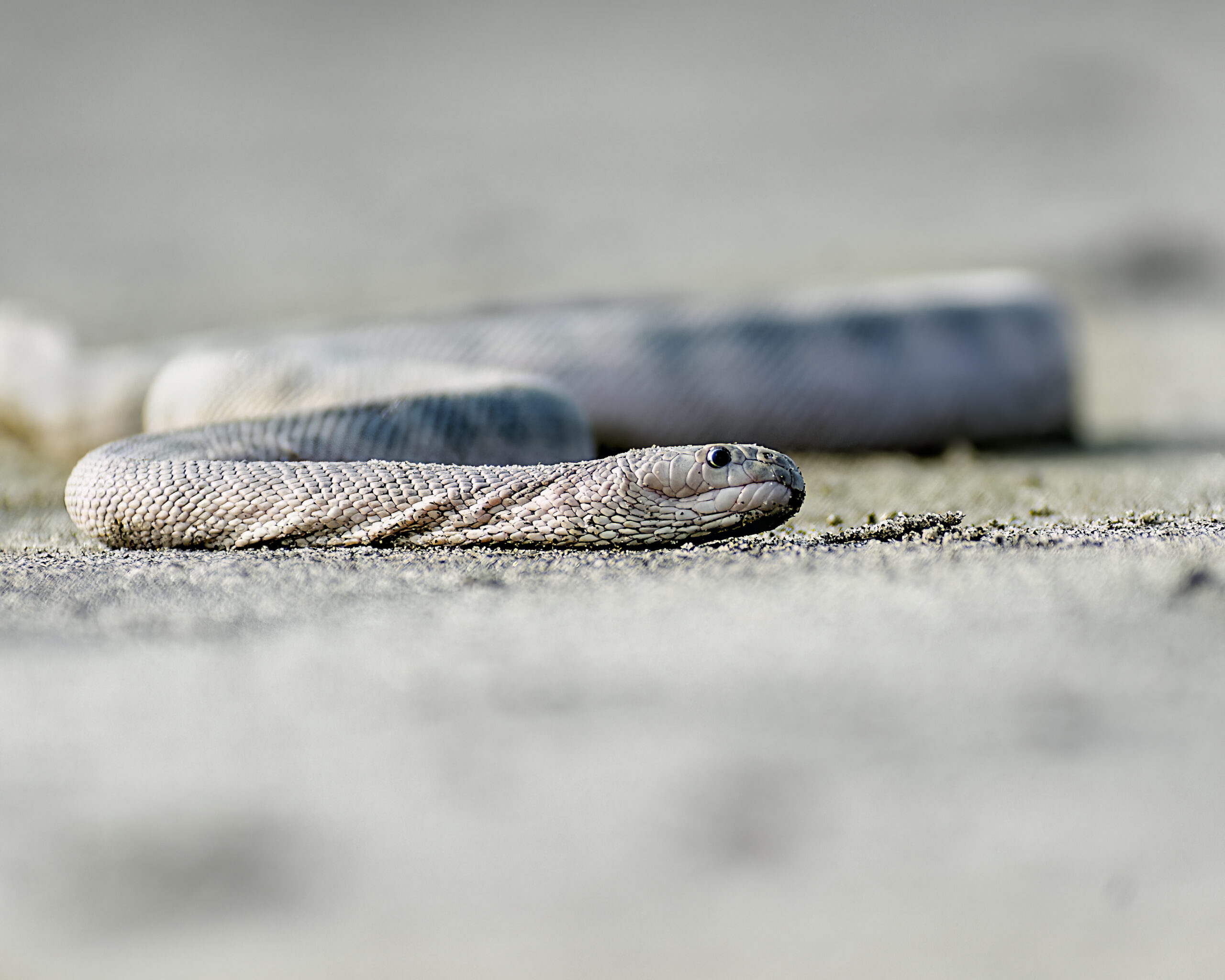
Hook-Nosed Sea Snake (Hydrophis schistosus) is a living marine elapid also called the beaked or common sea snake. Older references often use the synonym Enhydrina schistosa, while current reptile and marine databases accept Hydrophis schistosus. This guide separates well-supported biology from common assumptions and covers identification, range, habitat, diet, behavior, reproduction and conservation.
Identification
The species has a stout body, a short laterally compressed paddle-like tail and a distinctive beaklike snout with the upper jaw projecting downward. Young snakes show dark crossbands or rings over a pale gray to olive ground; the bands can fade as adults become more uniformly gray. The head is relatively small and the ventral scales are reduced, reflecting a fully aquatic life. Females generally grow larger and heavier than males. Sex is not reliably determined from color alone, and size overlaps among ages and populations.
Identification should combine body shape, markings, size, voice or movement, and location. One feature by itself can overlap with a related animal, a juvenile, or an individual in unusual light.
Photographs are most useful when they preserve scale and show several diagnostic features. Handling or repositioning a wild hook-nosed sea snake for identification can cause stress and is unnecessary.
Size and physical adaptations
Hook-Nosed Sea Snake typically measures commonly around 90 cm, with reported total length up to about 140 cm and weighs variable and not represented by a dependable species-wide average. Published maximum length is about 140 cm, although many adults are shorter. Sex, age and population affect size, and exceptional records should not be treated as typical.
Its useful adaptations include paddle-shaped tail for propulsion, valved nostrils that reduce water entry, reduced belly scales suited to swimming rather than land movement, salt-excreting glands associated with marine life, potent venom used to immobilize fish. These traits work together in the animal’s normal setting rather than serving as isolated curiosities.
Published measurements may use different methods, life stages or sample locations. Comparing figures responsibly means checking what was measured rather than selecting the largest number available.
Range and distribution
The accepted Asian species occurs from coastal Pakistan and India through Sri Lanka and the Bay of Bengal to parts of mainland and peninsular Southeast Asia. Records are concentrated in suitable coastal waters rather than spread evenly through every listed country. The native range includes Pakistan, India, Sri Lanka, Bangladesh, Myanmar, Thailand, Vietnam, Malaysia, Singapore.
A country-level map indicates broad distribution, not continuous occupation. Climate, elevation, water, vegetation, prey, breeding sites, barriers and survey effort all affect where records occur.
Records near the edge of the range deserve careful documentation because they may reflect natural movement, improved survey coverage, accidental transport or a genuine distribution change.
Habitat
Shallow tropical coastal water, estuaries, river mouths, tidal rivers, mangrove channels and nearby soft-bottom marine habitat, usually in relatively shallow depths.
The snake forages in turbid inshore water and can enter estuarine or tidal fresh water. Its association with fishing grounds makes accidental capture in gillnets, shore seines and trawls a recurring concern. Protecting a population therefore requires the feeding, shelter and breeding features that make a site usable, along with connections that allow movement.
Microhabitat matters. Shade, soil, current, moisture, shelter or host plants can determine whether a small area is usable even when the surrounding landscape appears suitable.
Diet and feeding
Hook-Nosed Sea Snake is a carnivore specializing mainly on fish. Important foods include fish, eels and eel-like fishes, gobies, other small coastal fishes. It searches shallow water for fish, seizes prey with the jaws and uses venom to immobilize it before swallowing. Diet varies with prey availability and local habitat, so individual stomach records should not be generalized to every population.
Diet changes with age, season, location and food supply. A dramatic prey record does not establish what most individuals eat most of the time; repeated field observations provide a stronger picture.
Feeding opportunities also create risk. An animal focused on prey may be less alert to predators, traffic or people, while contaminated prey can transfer pollutants through the food web.
Behavior and communication
Aquatic activity follows prey, tides, temperature and local conditions rather than a fixed universal day-night schedule. The species spends virtually its entire life in water and is poorly adapted to crawling on land. It usually avoids people, but a trapped or handled snake can defend itself. Fishers are at greatest risk when removing snakes from nets or catches.
Chemical cues and close body contact are important in finding mates and prey. Like other snakes, it samples chemicals with tongue-flicking; underwater sensory biology remains less visible to observers than its swimming behavior. Behavior should be interpreted in context: alarm, courtship, feeding and temperature regulation can produce very different actions from the same animal.
Daily schedules are flexible responses, not rigid rules. Weather, breeding condition, disturbance, tides or food can move activity into a different part of the day.
Reproduction and development
Mating and birth occur in the water. Females retain embryos and give birth to live young, an adaptation that removes any need to crawl ashore for nesting. Published accounts commonly report about 4–9 live young, with variation among females and studies. Newborns are fully formed swimmers and receive no prolonged parental care. Young snakes show more conspicuous dark bands than many adults.
Young animals face different risks and may use different microhabitats or food than adults. Breeding success depends on adult condition, suitable sites and the survival of offspring through vulnerable early stages.
Counts of eggs or young describe reproductive output, not the number expected to reach adulthood. Mortality is normally greatest during eggs, larval or juvenile stages.
Predators and ecological role
By preying on coastal fishes, the hook-nosed sea snake participates in shallow-water food webs and in turn can be eaten by large predatory fishes, sharks and birds. Its frequent interaction with fisheries also makes it useful for studying how bycatch affects air-breathing marine reptiles. Documented or likely predators include Sharks, Large Predatory Fish, Sea Eagles.
This animal is both a consumer and a food source. Its influence comes through many repeated interactions, so ecological claims should be based on measured populations rather than assumptions drawn from appearance.
Predator and prey relationships differ among places. A species can be ecologically influential without being abundant everywhere, and its role can change across its range.
Relationship with people
The species overlaps heavily with coastal fisheries and is often captured accidentally. It should never be handled: sea-snake bites can be medically serious even when the initial wound looks small. Bycatch reduction and careful fisher education can protect both people and snakes.
Keep clear of any sea snake in the water or on shore and do not attempt rescue or identification by hand. Fishers should use trained, tool-based release procedures. After any suspected bite, seek urgent medical care immediately and avoid cutting, sucking or applying a tight tourniquet. Responsible observation means keeping an appropriate distance, avoiding capture or feeding, protecting habitat and following local wildlife or invasive-species guidance.
Wildlife guidance should come from the responsible local agency because collection rules, reporting requests and appropriate responses differ between native and introduced ranges.
Conservation
The IUCN assessment lists Hydrophis schistosus as Least Concern, but this global category does not eliminate local mortality from fishing bycatch, deliberate killing or coastal habitat degradation. The reported global trend is Not represented here by a dependable current global population trend.
Important pressures include gillnet, seine and trawl bycatch, deliberate killing after capture, coastal habitat degradation, pollution, prey and food-web changes. Global status can hide local decline or recovery, so current regional monitoring and habitat management remain necessary.
The most useful conservation action follows the documented pressure. Protecting breeding sites, reducing road deaths or limiting pollutants can require different tools in different populations.